

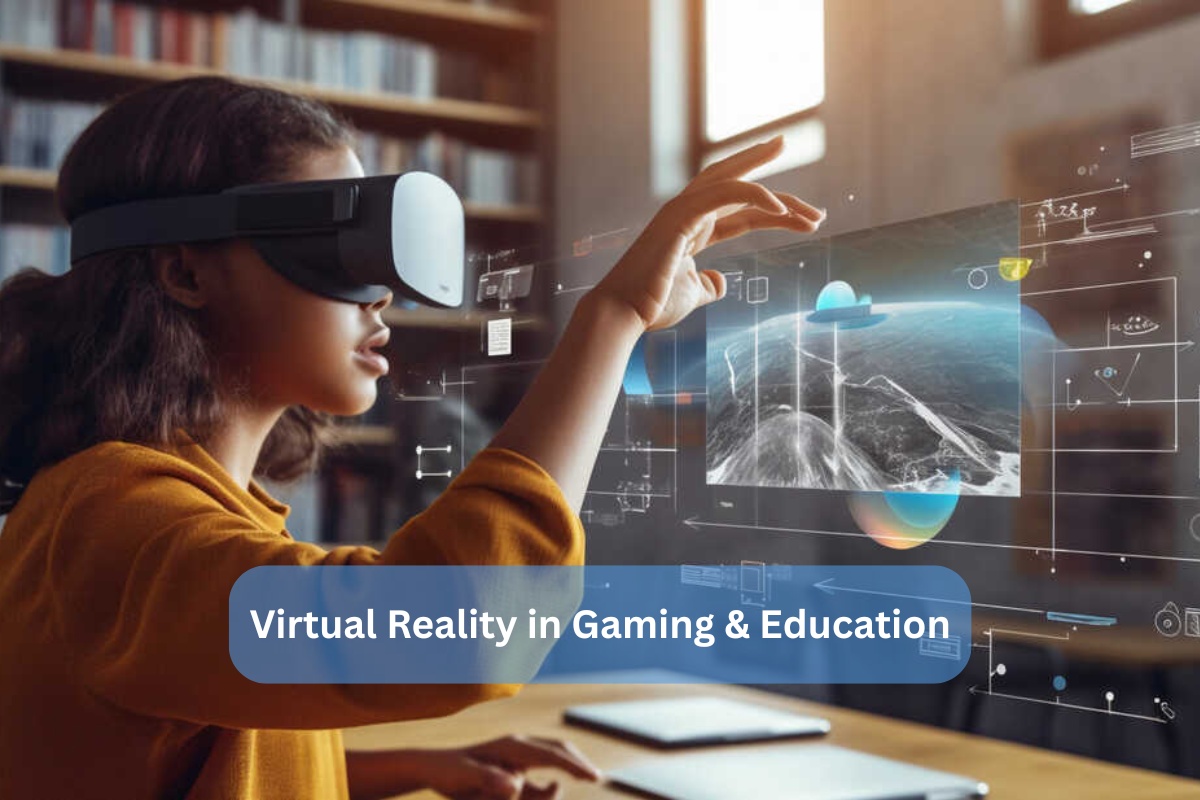
Virtual Reality (VR) has evolved from a niche technology to a mainstream force shaping the future of entertainment, education, and even professional training. Once limited to science fiction novels and movies, VR has now entered our homes, classrooms, and workplaces, offering immersive experiences that were unimaginable just a decade ago. Among the many sectors VR is transforming, gaming and education stand out as two areas where its impact is profound.
In this article, we will explore the future of VR in both gaming and education, examining current trends, potential innovations, challenges, and the benefits that VR can bring to users of all ages.
Virtual Reality in Gaming
The Rise of Immersive Gaming
The gaming industry has always been at the forefront of adopting new technology, and VR is no exception. VR gaming allows players to step inside their favorite worlds, interacting with the environment in ways that traditional consoles or PC setups cannot offer. With devices like the Oculus Quest, PlayStation VR2, and HTC Vive, gamers can experience lifelike interactions that enhance the overall gameplay experience.
Unlike traditional gaming, VR immerses the player physically into the game. Whether it’s swinging a sword, flying a spaceship, or exploring ancient ruins, VR transforms gaming from a passive activity into an active, physical experience. This level of immersion is changing the way we think about storytelling, character interaction, and game design.
Summary Table: How Virtual Reality Impacts Gaming and Education
| Factor | Role in VR Experience | Impact if Poorly Implemented | Best Practice/Implementation |
|---|---|---|---|
| Immersion & Realism | Engages users deeply, critical for learning | Low-quality graphics break immersion, reduce learning | Use high-resolution displays & realistic simulations |
| Latency & Performance | Smooth experience prevents motion sickness | Laggy VR causes nausea, reduces engagement | Optimize hardware & software for low latency |
| Interactivity & Controls | Enables natural user interaction | Complex or unresponsive controls frustrate users | Use intuitive controllers & haptic feedback |
| Content Relevance | Educational VR must teach effectively | Irrelevant or poor content reduces retention | Curate interactive, goal-oriented VR modules |
| Multiplayer & Collaboration | Encourages teamwork & social learning | Poor networking causes disconnection & delays | Use reliable networking & real-time collaboration |
| Accessibility & Comfort | Ensures VR usable by all ages | Heavy or uncomfortable devices limit session length | Ergonomic design, adjustable settings |
| Hardware Compatibility | Supports widespread adoption | Incompatible devices block access | Develop for multiple VR headsets & platforms |
| Safety & Motion Sickness | Prevents negative user experiences | Excessive motion leads to health complaints | Implement comfort settings & gradual motion |
| Scalability for Education/Gaming | Handles multiple users or classrooms | System crashes with many users | Cloud-based VR solutions & server optimization |
| Cost vs Benefit | Budget-friendly solutions for schools/gamers | Expensive setups limit adoption | Evaluate ROI, start with affordable VR kits |
VR Hardware & Software Pricing (2025 Approx.)
| Product/Service | Price Range (INR) | Notes |
|---|---|---|
| VR Headsets (Oculus Quest 3, etc.) | ₹30,000 – ₹60,000 | Standalone VR, wireless, suitable for gaming & education |
| High-End PC for VR | ₹80,000 – ₹1,50,000 | Required for tethered VR experiences |
| VR Controllers & Accessories | ₹5,000 – ₹15,000 | Motion tracking, haptic feedback |
| VR Software (Games/Educational) | ₹500 – ₹5,000 per license | Subscription or one-time purchase |
| VR Learning Platforms | ₹10,000 – ₹50,000 yearly | Schools/universities, multi-user access |
| VR Cloud/Streaming Services | ₹5,000 – ₹20,000 yearly | For scalable multi-user or classroom deployment |
Future Trends in VR Gaming
-
Wireless and Lightweight Headsets:
Early VR devices were bulky and tethered to powerful PCs. The future is wireless, with lightweight headsets offering high-quality graphics and longer battery life. This development will make VR more accessible and comfortable for extended gaming sessions. -
Haptic Feedback and Full-Body Tracking:
Advanced haptic suits and gloves will allow players to feel textures, impacts, and even temperature changes in the game world. Full-body tracking ensures that movements are mirrored in real time, enhancing realism. -
Social VR Experiences:
VR gaming is evolving into a social platform. Games like VRChat and Rec Room are creating virtual spaces where players can socialize, collaborate, and compete in immersive worlds. This trend is likely to grow as VR becomes a hub for online social interaction. -
AI Integration in VR Gaming:
Artificial Intelligence will play a major role in creating smarter NPCs (non-player characters), adaptive game scenarios, and personalized experiences. AI can enhance realism and provide endless replayability for gamers. -
Cross-Platform VR Gaming:
In the future, players will be able to move seamlessly between VR, AR, and traditional gaming platforms. This integration will make it easier to share experiences and compete with friends, regardless of the device used.
Challenges in VR Gaming
Despite its potential, VR gaming still faces several hurdles:
-
Cost: High-quality VR setups are expensive, limiting accessibility.
-
Motion Sickness: Some players experience discomfort due to mismatched motion cues.
-
Content Availability: VR-exclusive games are still fewer compared to traditional platforms.
-
Physical Space Requirements: Not everyone has enough room for VR movement, which may restrict its adoption.
Nonetheless, technological advancements continue to address these challenges, making VR gaming more practical and enjoyable for a wider audience.
Virtual Reality in Education
Revolutionizing the Classroom
Education is another sector where VR has the potential to create transformative experiences. Traditional classrooms rely heavily on books, lectures, and 2D visuals. VR breaks these limitations, offering students a chance to interact with content in three dimensions, explore virtual environments, and learn through experience.
For example, instead of reading about the solar system, students can explore planets, orbit satellites, and witness astronomical phenomena firsthand. Medical students can perform virtual surgeries, engineers can assemble complex machinery, and history students can walk through ancient civilizations—all in a safe, controlled virtual environment.
Applications of VR in Education
-
Virtual Field Trips:
VR can take students on immersive trips to far-off places, historical landmarks, or natural wonders without leaving the classroom. This provides experiential learning that enhances memory retention and engagement. -
Skill-Based Training:
VR is ideal for vocational and professional training. Fields like aviation, medicine, and engineering benefit greatly, as students can practice skills without real-world consequences. -
Special Education:
VR creates tailored learning environments for students with special needs, providing interactive and adaptive experiences that cater to individual learning styles. -
STEM Education:
Complex concepts in science, technology, engineering, and math become easier to understand when visualized in 3D. VR allows students to manipulate molecules, explore physics simulations, or conduct virtual experiments. -
Language Learning:
Immersive environments can accelerate language acquisition by simulating real-life scenarios where students practice conversations, cultural etiquette, and context-based learning.
Future Trends in VR Education
-
AI-Powered Adaptive Learning:
AI algorithms can analyze student performance in real time and tailor VR content accordingly, ensuring personalized learning paths for each student. -
Collaborative VR Classrooms:
Students from around the world can meet in virtual classrooms, collaborate on projects, and interact with teachers in real time. This fosters a global learning environment. -
Gamification of Learning:
By incorporating game mechanics into VR education, lessons become more engaging and interactive. Students can earn rewards, complete challenges, and compete in knowledge-based games. -
Integration with Augmented Reality (AR):
Combining VR with AR creates mixed reality experiences where virtual objects interact with real-world elements, making learning even more dynamic and hands-on. -
Immersive Assessment Techniques:
VR allows educators to evaluate students in practical, scenario-based tasks rather than traditional exams. This approach measures applied knowledge and critical thinking.
Challenges in VR Education
While promising, VR in education faces some barriers:
-
High Costs of Equipment: Many schools cannot afford VR headsets and software.
-
Teacher Training: Educators need to be trained to integrate VR effectively into their curriculum.
-
Content Development: Creating high-quality VR educational content is expensive and time-consuming.
-
Health Concerns: Long periods of VR use can lead to eye strain or motion sickness, especially among younger students.
Despite these challenges, VR is steadily gaining traction in schools, universities, and corporate training programs worldwide.
The Intersection of Gaming and Education
Interestingly, VR gaming and education are converging in a unique way. Educational games use immersive gameplay to teach real-world skills. Gamified VR lessons enhance engagement, making learning feel less like a chore and more like an adventure. For instance:
-
Minecraft: Education Edition teaches coding, history, and architecture in a virtual sandbox.
-
Labster VR allows students to perform chemical and biological experiments safely.
-
Tilt Brush and Gravity Sketch introduce art and design concepts through creative VR tools.
The future promises even deeper integration where the boundaries between learning and play blur, creating experiences that are both educational and entertaining.
Benefits of VR in Gaming and Education
-
Enhanced Engagement: VR captivates attention like no other medium, keeping users focused and motivated.
-
Experiential Learning: Both gamers and students learn through action and immersion, improving retention.
-
Accessibility: Virtual worlds allow people to experience environments that may be physically or financially out of reach.
-
Safe Environment for Experimentation: Mistakes in VR are low-risk, whether in gaming or skill training.
-
Global Connectivity: Multiplayer VR games and virtual classrooms connect users worldwide, fostering collaboration and cultural exchange.
Looking Ahead: The Future of VR
The potential for VR in gaming and education is virtually limitless. As hardware becomes more affordable, software more sophisticated, and content more diverse, VR will likely become a staple in homes and schools alike.
Key predictions for the next decade include:
-
VR headsets becoming as common as smartphones.
-
AI-driven content personalization in both games and lessons.
-
Widespread adoption of VR in corporate training, remote work, and higher education.
-
Increased hybrid experiences combining VR, AR, and real-world interactions.
The convergence of technology, creativity, and education ensures that VR will continue to revolutionize the way we play, learn, and interact with the world around us.
Conclusion
Virtual Reality is no longer a futuristic concept—it’s an evolving reality reshaping the way we learn and play. From immersive gaming worlds to interactive classrooms, VR offers endless opportunities for growth, engagement, and innovation. While challenges remain, the ongoing advancements in hardware, software, and content creation are making VR more accessible and impactful every day.
For gamers and educators alike, embracing VR is not just about keeping up with technology—it’s about stepping into a world of limitless possibilities.
